Solar, Mains or Home Battery: Which EV Charging Setup Is Right for Your Home?

Quick Facts: EV Charging Setup Options
|
You've got a wall charger sorted, or you're about to.
The next question most EV owners hit somewhere around month two is this: should I be smarter about how I'm charging? Which leads to: "which is best? Solar, Mains or Home Battery EV charging"
With electricity prices up, feed-in tariffs down, and half your street apparently talking about solar panels, the "just plug it in" approach starts to feel like leaving money on the table.
The good news: there are genuinely three different setups available to Australian EV owners, they suit different households, and the difference in what you actually pay over three years is significant enough to be worth ten minutes thinking through now.
Option 1: Straight mains charging
This is what most EV owners start with.
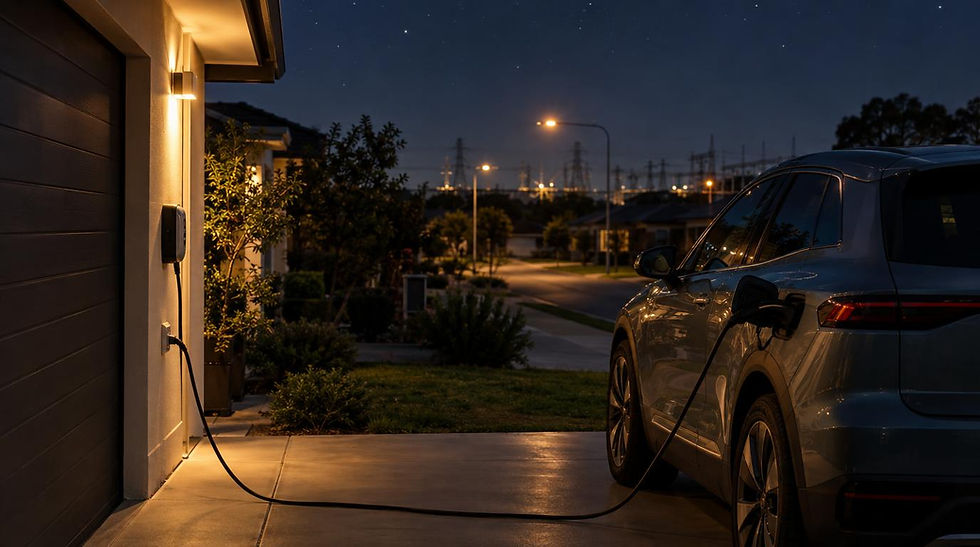
The wall charger is installed, you plug in when you get home, it charges at the standard grid tariff overnight, done.
It works, it's reliable, and for the first few months it feels like a revelation compared to petrol prices. The average Australian standard tariff sits between roughly 26 and 36 cents per kWh depending on your state and retailer, with South Australia typically running higher again.
At 30c/kWh, charging a 60kWh battery from empty costs around $18. Compare that to filling a 55 litre petrol tank at $2.40 a litre, around $132, and even straight mains EV charging looks like a bargain.
The catch is that you're paying peak rates for every charge unless you actively shift to an off-peak tariff (see below), and over a few years those rates tend to drift up.
Mains charging is perfectly fine as a starting point, it's just not the ceiling.
Best for: renters, apartment dwellers without solar access, or anyone who wants simple and doesn't want to think about it.
Option 1a: Off-peak mains, the underrated quick win
Most major Australian electricity retailers offer a time-of-use tariff with an off-peak window, typically 10pm to 7am, at rates commonly between 15 and 22 cents per kWh depending on your state, network and retailer.
That's meaningfully cheaper than the standard rate for the same electricity, on the same grid connection you already have.
Most EVs let you schedule charging via the car's infotainment or companion app. Set your departure time, let the car work backwards.
You don't need a smart charger, you don't need solar, and you don't need a new electricity contract, just call your retailer and ask if a time-of-use plan is available.
For many Australians this is the highest-return, lowest-effort change on this entire list.
Best for: anyone who isn't on a time-of-use tariff yet. Do this first, before anything else.
Option 2: Solar charging
If you have rooftop solar, or you're considering adding it, this is where the economics of EV ownership get genuinely interesting.
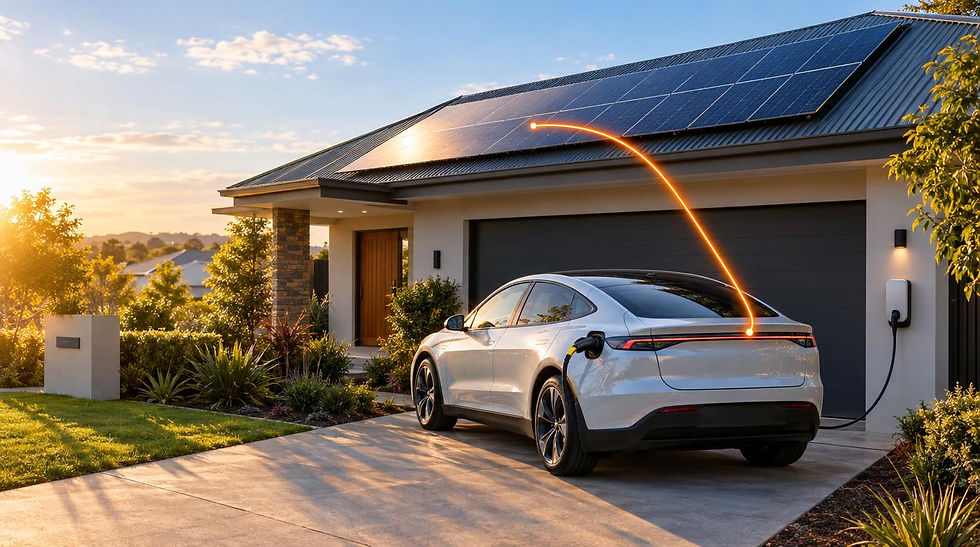
Australian households typically generate more solar power between about 10am and 3pm than they can use domestically. That excess is either exported to the grid at the feed-in tariff (typically 3 to 10 cents per kWh in most states, and generally falling) or wasted entirely if the export cap has been reached.
An EV battery is a natural home for that surplus.
A standard 7kW home wall charger running during peak solar hours draws roughly the same power as a medium-sized ducted air conditioner, a demand most solar systems with 5kW+ capacity can handle without touching grid power.
The challenge: you need a solar-aware smart charger to do this automatically.
A dumb wall charger will happily run from the grid even when the sun is blazing because it has no visibility into your solar generation.
A smart charger like the myenergi Zappi v2 monitors your solar output in real time and automatically adjusts charging speed to consume only what your panels are producing, essentially free kilometres, most days.
Effective cost per kWh from solar: roughly 5 cents (the cost attributed to solar self-consumption rather than export revenue forgone, and it will sit closer to your actual feed-in tariff rate). At scale, the difference is around $9 to $15 per full charge via solar versus $18 via standard mains, a small per-charge gap that compounds over five years and 50,000km into something meaningful.
Best for: homeowners with existing 5kW+ solar systems who drive primarily Monday to Friday and can charge during the day, or who can set a flexible departure time to let the car charge through peak solar hours.
Option 3: Home battery plus EV charging
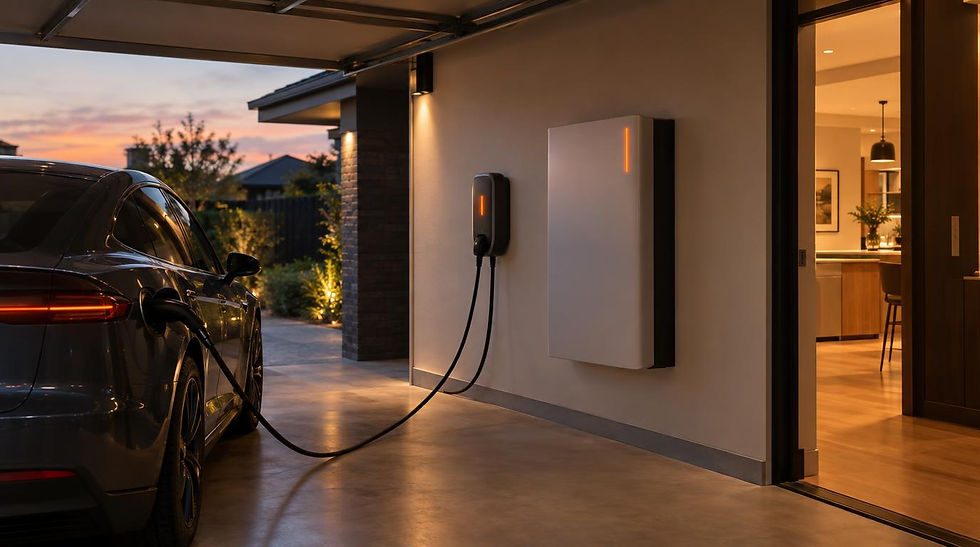
Adding a home battery (think Tesla Powerwall 3, BYD HVM, Sungrow SBR) into the mix gives you a second reservoir.
Solar charges the battery during the day; the battery charges the EV in the evening or overnight. The EV never needs to see a grid rate again in ideal conditions.
This is the setup with the most energy independence, and the highest upfront cost. A quality home battery system suitable for EV charging typically adds $8,000 to $15,000 to your energy setup. The maths only works cleanly if:
You already have solar (or are installing it alongside)
Your daily EV energy demand doesn't drain the home battery completely before the house has had its own evening needs met
Your feed-in tariff is low enough that storing excess rather than exporting it is genuinely worth doing (almost always yes, at current FiT rates)
The practical sizing reality: a typical Australian household uses 18 to 22kWh a day including an EV. A 10kWh home battery alone doesn't cover this. Most owners in this setup use the battery to cover peak household demand and overnight EV top-ups, then let the solar do the heavy lifting during the day.
Best for: homeowners who have already invested in solar, are planning to stay in their home for 7+ years, and want maximum independence from grid pricing.
Cost Comparison: Three Charging Setups
Setup | Effective cost/kWh | Full charge (60kWh) | Annual cost (15,000km at 18kWh/100km) |
Standard mains (30c/kWh) | 30c | ~$18.00 | ~$810 |
Off-peak mains (18c/kWh) | 18c | ~$10.80 | ~$486 |
Solar (smart charger, ~5c attributed cost) | ~5c | ~$3.00 | ~$135 |
Solar plus home battery (overnight discharge) | ~5-8c blended | ~$3-5 | ~$135-225 |
Petrol (10L/100km at $2.40/L) | - | - | ~$3,600 |
Figures are indicative averages based on mid-2026 Australian energy prices and vary significantly by state, retailer and solar system size.

Do This, Don't Do That
Do this first: switch to an off-peak tariff. It costs nothing, requires one phone call to your retailer, and roughly halves your charging bill immediately compared to a standard flat rate.
Do this if you already have solar: add a smart charger (budget $700 to $1,200 installed) and you'll be running close to free during daylight hours within a week of installation.
Don't do this: add a home battery purely to justify cheaper EV charging. It's rarely the right first move on that basis alone, the numbers usually need solar self-consumption plus household peak-shaving to stack up as well.
The one thing that cuts through all of this: run the numbers on your own bill, with your own retailer's rates, before making any hardware decision.
Solar, Mains or Home Battery EV charging : FAQs
Do I need a special charger to use solar to charge my EV? Yes, a solar-aware smart charger. A standard wall charger has no visibility into your solar output and will draw from the grid regardless. Chargers like the myenergi Zappi v2 and Ocular IQ Home Solar monitor your generation in real time and adjust charging speed accordingly.
Can I charge my EV for free with solar? Effectively, close to it, during peak solar hours with a smart charger and a sufficient solar system (5kW+ recommended for a 7kW charger). The electricity itself comes from your panels, which have already been paid for, the attributed cost is the foregone export revenue, currently around 3 to 10 cents per kWh depending on your state.
Is a home battery worth it just for EV charging? Rarely as a standalone decision. Home batteries work best when they serve multiple purposes, reducing peak household tariffs, covering evening demand, and then supporting EV charging. Running the numbers on your specific usage pattern and current feed-in tariff rate is essential before committing.
What is the cheapest time to charge an EV in Australia? During daytime solar generation (effectively close to free with a smart charger and solar), or during the off-peak overnight window on a time-of-use tariff, typically 10pm to 7am, at roughly 15 to 22 cents per kWh depending on your state and retailer.


Comments